Industrial Flammability Tester Guide: UL 94, ISO 4589, and Precision Flame Characterization
Comprehensive engineering guide to flammability testing equipment. Discover combustion mechanics, UL 94 and ISO standards, calibration protocols, and testing systems.
Environmental Test Chamber Climate Test Chamber Salt Spray Test Chamber UV Aging Test Chamber Thermal Shock Test Chamber Dust Test Chamber Rain Test Chamber Boiling Test Chamber Dry Dehumidification Cabinet Xenon Test Chamber Universal Tensile Test Equipment Single Column Series Double Column Series Fixtures Drying Oven 200℃ Oven 300℃ Oven 400℃ Oven 500℃ Oven Vacuum Oven 27L Vacuum Oven 64L Vacuum Oven 125L Vacuum Oven 216L Vacuum Oven 512L Vacuum Oven 729L Vacuum Oven 1000L Vacuum Oven Two-box Vacuum Oven Three-box Vacuum Oven Vibration Shaker Table System Simulated Transportation Vibration Table Vertical Vibration Table Vertical Horizontal Vibration Table XYZ Three Axis Vibration Table Rubber And Plastic Test Equipment VICAT Tester Melt Flow Index Tester Flammability Test Equipment Charpy & Izod Impact Tester Paper Packaging Test Equipment Edge And Ring Crush Tester Drop Tester Carton Compression Tester Bursting Strength Tester Battery Test Equipment Videos About Us Our Partners & Clients Certifications & Honors Factory & Gallery Why Choose HAOEN Company Profile News Company News Industry News Contact 🇺🇸 English 🇫🇷 Français 🇩🇪 Deutsch 🇪🇸 Español .ml-sw{font-family:inherit;font-size:14px;line-height:1.5}.ml-dropdown{position:relative;display:inline-block;z-index:999}.ml-dd-trigger{display:flex;align-items:center;gap:6px;cursor:pointer;padding:4px 10px;border-radius:var(--ml-radius);color:var(--ml-text);transition:background .2s}.ml-dd-trigger:hover{background:rgba(0,0,0,.05)}.ml-dd-flag{font-size:18px}.ml-dd-icon{vertical-align:middle}.ml-dd-arrow{border:4px solid transparent;border-top:5px solid currentColor;margin-top:2px;transition:transform .2s}.ml-dropdown.open .ml-dd-arrow{transform:rotate(180deg)}.ml-dd-panel{display:none;position:absolute;top:100%;left:0;min-width:100%;width:max-content;background:var(--ml-bg);border-radius:var(--ml-radius);box-shadow:0 4px 16px rgba(0,0,0,.12);padding:4px 0;margin-top:4px}.ml-dropdown.open .ml-dd-panel{display:block}.ml-dd-item{display:flex;align-items:center;gap:8px;padding:8px 14px;color:var(--ml-text);text-decoration:none;transition:background .15s;white-space:nowrap}.ml-dd-item:hover{background:rgba(0,0,0,.04)}.ml-dd-item.active{color:var(--ml-primary);font-weight:500}.ml-dd-chk{margin-left:auto;font-size:12px}.ml-pills{display:flex;flex-wrap:nowrap;gap:6px;white-space:nowrap}.ml-pill{display:inline-flex;align-items:center;gap:4px;padding:4px 12px;border-radius:var(--ml-radius);background:var(--ml-bg);color:var(--ml-text);text-decoration:none;border:1px solid rgba(0,0,0,.1);transition:all .2s;font-size:13px;white-space:nowrap}.ml-pill:hover{border-color:var(--ml-primary);color:var(--ml-primary)}.ml-pill.active{background:var(--ml-primary);color:#fff;border-color:var(--ml-primary)}.ml-pill-flag{font-size:16px}.ml-bar{display:flex;gap:0;border-bottom:2px solid rgba(0,0,0,.06);white-space:nowrap}.ml-bar-item{display:inline-flex;align-items:center;gap:4px;padding:6px 14px;color:var(--ml-text);text-decoration:none;border-bottom:2px solid transparent;margin-bottom:-2px;transition:all .2s;font-size:13px;white-space:nowrap}.ml-bar-item:hover{color:var(--ml-primary)}.ml-bar-item.active{color:var(--ml-primary);border-bottom-color:var(--ml-primary);font-weight:500}.ml-bar-flag{font-size:16px}.ml-float{position:fixed;right:20px;bottom:20px;z-index:9999}.ml-float-btn{width:48px;height:48px;border-radius:50%;background:var(--ml-primary);color:#fff;border:none;cursor:pointer;box-shadow:0 4px 12px rgba(0,0,0,.2);transition:transform .2s;display:flex;align-items:center;justify-content:center;padding:0;line-height:1}.ml-float-btn:hover{transform:scale(1.1)}.ml-float-btn svg{width:24px;height:24px;display:block}.ml-float-panel{display:none;position:absolute;bottom:56px;right:0;min-width:160px;background:var(--ml-bg);border-radius:var(--ml-radius);box-shadow:0 4px 16px rgba(0,0,0,.12);padding:4px 0}.ml-float.open .ml-float-panel{display:block}.ml-float-item{display:flex;align-items:center;gap:8px;padding:8px 14px;color:var(--ml-text);text-decoration:none;transition:background .15s}.ml-float-item:hover{background:rgba(0,0,0,.04)}.ml-float-item.active{color:var(--ml-primary);font-weight:500}.ml-float-flag{font-size:18px} function mlSwToggle(){var e=document.getElementById("mlSw");if(e)e.classList.toggle("open")}document.addEventListener("click",function(e){var s=document.getElementById("mlSw");if(s&&!s.contains(e.target))s.classList.remove("open")}); News & Updates Stay informed with the latest industry news and company updates
News & Updates
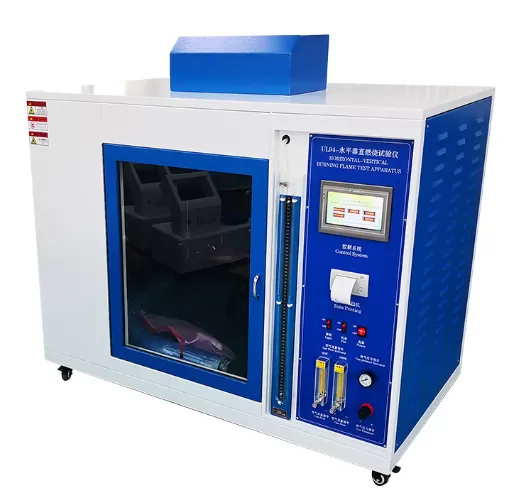
News Industry News Industry News Industrial Flammability Tester Guide: UL 94, ISO 4589, and Precision Flame Characterization 2026-09-12 Industry News 1 views Thermal stability and fire reaction testing form the foundation of material validation across modern manufacturing. Whether developing non-metallic enclosures for electronic subassemblies, composite panels for mass transit interiors, or functional synthetic textiles, engineers must predict how a specimen responds when exposed to localized thermal ignition sources. Evaluating this behavior requires an advanced flammability tester designed to simulate standard fire scenarios within tightly controlled boundary conditions. Accurate performance quantification protects downstream industrial applications from catastrophic structural loss, non-compliance penalties, and irreversible product recalls.
Quantifying flame propagation demands an intimate understanding of chemical kinetics, heat transfer dynamics, and fluid mechanics. Standardized evaluation protocols replace subjective observation with objective, reproducible metrics such as afterflame duration, dripping behavior, ignition of secondary substrates, and linear burn velocity. Achieving this level of testing precision hinges on purpose-built apparatuses engineered to eliminate ambient environmental interference, optimize burner fuel dynamics, and maintain rigid positional tolerances.
The Physics and Chemical Dynamics of Laboratory Flame Characterization
Solid-phase materials undergo distinct degradation phases prior to and during sustained combustion. When an external flame impinges upon a polymer matrix, the local surface temperature escalates toward its specific thermal decomposition threshold. This thermodynamic disruption triggers pyrolysis, yielding volatile monomer fractions, combustible hydrocarbons, and non-volatile carbonaceous char.
Combustion occurs within the boundary layer directly above the specimen surface, where pyrolyzed gaseous fractions mix with atmospheric oxygen. Once the activation energy threshold is crossed, rapid exothermic oxidation establishes a self-sustaining flame envelope. The primary technical purpose of a flammability tester is to subject the specimen to a controlled quantity of thermal energy—characterized by specific heat flux, flame geometry, and exposure duration—and continuously track the rate at which the material propagates or extinguishes the combustion event.
Structural Architecture and Hardware Requirements of Testing Systems
Several mechanical and atmospheric variables destabilize this chemical process during empirical testing:
Chamber Draft and Ambient Velocity: Undesirable convective currents alter the fuel-oxygen ratio at the flame front, artificially dissipating the thermal plume and distorting afterglow durations.
Standardization Frameworks: UL, ISO, ASTM, and IEC
Radiant Heat Feedback: In closed or semi-closed chambers, radiant reflections from interior structural walls can inadvertently elevate specimen baseline temperatures, skewing burn rate indices.
Specimen Thermophysical Inertia: Thermal conductivity, heat capacity, and sample density dictate whether heat remains localized at the surface or diffuses into the core, fundamentally changing the time-to-ignition.
Engineering Challenges in Testing Repeatability and Data Integrity
Drip Dynamics and Secondary Ignition: Thermoplastic resins undergo melt-phase transition, causing molten droplets to detach. The equipment must reliably identify whether these burning droplets carry sufficient thermal enthalpy to ignite target indicator materials beneath the primary clamp.
Designing an industrial-grade testing apparatus requires balancing structural robustness with sensitive micro-instrumentation. Testing enclosures endure repeated exposure to corrosive combustion byproducts, including hydrogen chloride, hydrofluoric acid, sulfur dioxide, and particulate carbon soot. Consequently, the interior chamber volume must feature grade 304 or 316 stainless steel with specialized passivation coatings, protecting mechanical carriages from progressive degradation.
Sector-Specific Applications: Tailoring Configurations to Material Classes
Burner mechanics represent the operational core of the system. In standard vertical and horizontal configurations, an authentic Bunsen or Tirrill burner barrel requires a precision needle valve, precise air intake shuttering, and absolute alignment mechanisms. Modern analytical test setups utilize mass flow controllers rather than basic rotameters to govern methane, propane, or butane supply lines. By measuring molecular mass flow independently of ambient gas temperature and line pressure fluctuations, computerized gas delivery eliminates baseline variances in total heat output.
Specimen positioning assemblies rely on precision-machined linear slides, multi-axis goniometers, and heavy-duty mechanical clamps. Clamp thermal conductivity must be optimized; excessively massive fixtures act as heat sinks that draw thermal energy away from the specimen edge, falsely improving flame-retardant performance ratings. Manufacturers such as HAOEN address this thermal transfer dynamic by integrating thermally isolated mounting jaws and ceramic mechanical breaks, ensuring that empirical energy inputs remain concentrated exclusively within the material's calibrated exposure zone.
Navigating global regulatory landscapes requires configuring testing hardware to satisfy multiple overlapping domestic and international standards. A properly specified flammability tester must adapt to distinct geometric configurations, gas delivery pressures, flame orientations, and data recording criteria depending on the target end-market.
UL 94 remains the prevailing benchmark for polymeric component safety across electrical devices, appliances, and industrial hardware. The protocol defines distinct horizontal (HB) and vertical (V-0, V-1, V-2, 5VA, 5VB) classification bands:
Horizontal Burning (HB): Establishes linear burn rates for non-self-extinguishing formulations across specimen thicknesses under 13 mm. Burn rate monitoring requires precise calibration of distance markers at 25 mm and 100 mm spans.
Vertical Burning (V-0, V-1, V-2): Involves two consecutive 10-second flame applications to the bottom edge of a vertically oriented test specimen. The apparatus tracks the afterflame time (t1) following the initial exposure, afterflame time (t2) plus afterglow time (t3) following the second exposure, and verifies whether dripping particles ignite surgical cotton situated 300 mm below the burn point.
豪恩如何制造该设备
上述设备在东莞市豪恩自有厂区自主设计与制造,而非由外购部件组装而成。 这一区别对需要多台设备表现一致的实验室具有实际意义。
- 箱体几何结构、气流组织与保温层厚度在设计阶段确定,制板阶段固化
- 制冷系统选型、传感器布置与控制逻辑调试均在自有厂区完成
- 出厂前在自有校准平台完成校准并出具单台证书
- 随机质检档案可追溯至生产车间