Industrial Flammability Test Equipment: Selection, Operation, and Maintenance
Explore technical guidance on flammability test equipment for plastics, cables, electronics, and building materials. Learn procurement, calibration, and maintenance.
Environmental Test Chamber Climate Test Chamber Salt Spray Test Chamber UV Aging Test Chamber Thermal Shock Test Chamber Dust Test Chamber Rain Test Chamber Boiling Test Chamber Dry Dehumidification Cabinet Xenon Test Chamber Universal Tensile Test Equipment Single Column Series Double Column Series Fixtures Drying Oven 200℃ Oven 300℃ Oven 400℃ Oven 500℃ Oven Vacuum Oven 27L Vacuum Oven 64L Vacuum Oven 125L Vacuum Oven 216L Vacuum Oven 512L Vacuum Oven 729L Vacuum Oven 1000L Vacuum Oven Two-box Vacuum Oven Three-box Vacuum Oven Vibration Shaker Table System Simulated Transportation Vibration Table Vertical Vibration Table Vertical Horizontal Vibration Table XYZ Three Axis Vibration Table Rubber And Plastic Test Equipment VICAT Tester Melt Flow Index Tester Flammability Test Equipment Charpy & Izod Impact Tester Paper Packaging Test Equipment Edge And Ring Crush Tester Drop Tester Carton Compression Tester Bursting Strength Tester Battery Test Equipment Videos About Us Our Partners & Clients Certifications & Honors Factory & Gallery Why Choose HAOEN Company Profile News Company News Industry News Contact 🇺🇸 English 🇫🇷 Français 🇩🇪 Deutsch 🇪🇸 Español .ml-sw{font-family:inherit;font-size:14px;line-height:1.5}.ml-dropdown{position:relative;display:inline-block;z-index:999}.ml-dd-trigger{display:flex;align-items:center;gap:6px;cursor:pointer;padding:4px 10px;border-radius:var(--ml-radius);color:var(--ml-text);transition:background .2s}.ml-dd-trigger:hover{background:rgba(0,0,0,.05)}.ml-dd-flag{font-size:18px}.ml-dd-icon{vertical-align:middle}.ml-dd-arrow{border:4px solid transparent;border-top:5px solid currentColor;margin-top:2px;transition:transform .2s}.ml-dropdown.open .ml-dd-arrow{transform:rotate(180deg)}.ml-dd-panel{display:none;position:absolute;top:100%;left:0;min-width:100%;width:max-content;background:var(--ml-bg);border-radius:var(--ml-radius);box-shadow:0 4px 16px rgba(0,0,0,.12);padding:4px 0;margin-top:4px}.ml-dropdown.open .ml-dd-panel{display:block}.ml-dd-item{display:flex;align-items:center;gap:8px;padding:8px 14px;color:var(--ml-text);text-decoration:none;transition:background .15s;white-space:nowrap}.ml-dd-item:hover{background:rgba(0,0,0,.04)}.ml-dd-item.active{color:var(--ml-primary);font-weight:500}.ml-dd-chk{margin-left:auto;font-size:12px}.ml-pills{display:flex;flex-wrap:nowrap;gap:6px;white-space:nowrap}.ml-pill{display:inline-flex;align-items:center;gap:4px;padding:4px 12px;border-radius:var(--ml-radius);background:var(--ml-bg);color:var(--ml-text);text-decoration:none;border:1px solid rgba(0,0,0,.1);transition:all .2s;font-size:13px;white-space:nowrap}.ml-pill:hover{border-color:var(--ml-primary);color:var(--ml-primary)}.ml-pill.active{background:var(--ml-primary);color:#fff;border-color:var(--ml-primary)}.ml-pill-flag{font-size:16px}.ml-bar{display:flex;gap:0;border-bottom:2px solid rgba(0,0,0,.06);white-space:nowrap}.ml-bar-item{display:inline-flex;align-items:center;gap:4px;padding:6px 14px;color:var(--ml-text);text-decoration:none;border-bottom:2px solid transparent;margin-bottom:-2px;transition:all .2s;font-size:13px;white-space:nowrap}.ml-bar-item:hover{color:var(--ml-primary)}.ml-bar-item.active{color:var(--ml-primary);border-bottom-color:var(--ml-primary);font-weight:500}.ml-bar-flag{font-size:16px}.ml-float{position:fixed;right:20px;bottom:20px;z-index:9999}.ml-float-btn{width:48px;height:48px;border-radius:50%;background:var(--ml-primary);color:#fff;border:none;cursor:pointer;box-shadow:0 4px 12px rgba(0,0,0,.2);transition:transform .2s;display:flex;align-items:center;justify-content:center;padding:0;line-height:1}.ml-float-btn:hover{transform:scale(1.1)}.ml-float-btn svg{width:24px;height:24px;display:block}.ml-float-panel{display:none;position:absolute;bottom:56px;right:0;min-width:160px;background:var(--ml-bg);border-radius:var(--ml-radius);box-shadow:0 4px 16px rgba(0,0,0,.12);padding:4px 0}.ml-float.open .ml-float-panel{display:block}.ml-float-item{display:flex;align-items:center;gap:8px;padding:8px 14px;color:var(--ml-text);text-decoration:none;transition:background .15s}.ml-float-item:hover{background:rgba(0,0,0,.04)}.ml-float-item.active{color:var(--ml-primary);font-weight:500}.ml-float-flag{font-size:18px} function mlSwToggle(){var e=document.getElementById("mlSw");if(e)e.classList.toggle("open")}document.addEventListener("click",function(e){var s=document.getElementById("mlSw");if(s&&!s.contains(e.target))s.classList.remove("open")}); News & Updates Stay informed with the latest industry news and company updates
News & Updates
News Industry News Industry News Industrial Flammability Test Equipment: Selection, Operation, and Maintenance 2026-09-10 Industry News 1 views Flammability test equipment sits at the center of product safety, regulatory compliance, and material research. For manufacturers, accredited laboratories, and distributors serving international markets, selecting the right system involves more than matching a standard number. It requires an understanding of ignition behavior, heat release, smoke generation, and how each measurement supports a broader fire performance strategy. A well-configured bench-scale apparatus can reveal how a polymer, cable jacket, textile, or composite behaves under controlled fire conditions, while a poorly specified system can produce variable results that slow approvals and weaken confidence in test reports.
International performance testing programs depend on repeatable methods, traceable data, and equipment that remains stable across thousands of cycles. Buyers often compare chamber volume, gas control, software, and service support, yet the most successful projects begin with a clear definition of the materials to be evaluated, the standards to be followed, and the decisions the data must support. That foundation shapes every later choice, from ignition source selection to exhaust design and long-term calibration planning.
How Flammability Test Equipment Fits Into International Performance Testing
Fire testing is not a single procedure. It is a family of methods that range from small-scale screening tests to instrumented combustion experiments. Each method answers a different question. A horizontal burn test may indicate whether a material self-extinguishes, while a cone calorimeter quantifies heat release rate, time to ignition, and smoke production under a controlled radiant heat flux. A limiting oxygen index system measures the minimum oxygen concentration needed to support combustion. Together, these tools help engineers predict fire risk, compare formulations, and demonstrate compliance with regional market requirements.
The ignition source defines the severity and realism of a test. A 50 W needle flame, a 500 W glow wire, a radiant cone heater, and a small open flame each create different thermal stress on a specimen. Choosing the wrong source can make a material appear safer or more hazardous than it is in its final application.
Core Technologies and Instrumentation in Modern Flammability Testing
Needle flame and glow-wire tests evaluate resistance to small ignition sources in electronics and appliances.
Vertical and horizontal burn tests assess flame spread, afterflame time, afterglow time, and char length.
Applications Across Regulated Industries
Cone calorimetry applies a uniform radiant heat flux to measure heat release rate, mass loss rate, and effective heat of combustion.
Limiting oxygen index testing determines the oxygen concentration required to sustain candle-like burning.
Procurement Criteria for Flammability Test Equipment
Smoke density and toxicity systems quantify optical density and gas species under controlled combustion.
Data quality depends on how well the instrument controls and records critical variables. Temperature, airflow, gas concentration, specimen orientation, and flame application time must remain within tight tolerances. Even small deviations can shift results enough to affect a pass or fail decision.
Common Operational Pain Points and Practical Solutions
Modern systems combine mechanical precision with digital control. A flammability chamber may look simple from the outside, but its performance depends on airflow straighteners, thermocouple placement, mass flow controllers, and software algorithms that compensate for environmental changes. The best instruments make these variables visible and adjustable, so laboratory teams can validate method parameters and troubleshoot anomalies quickly.
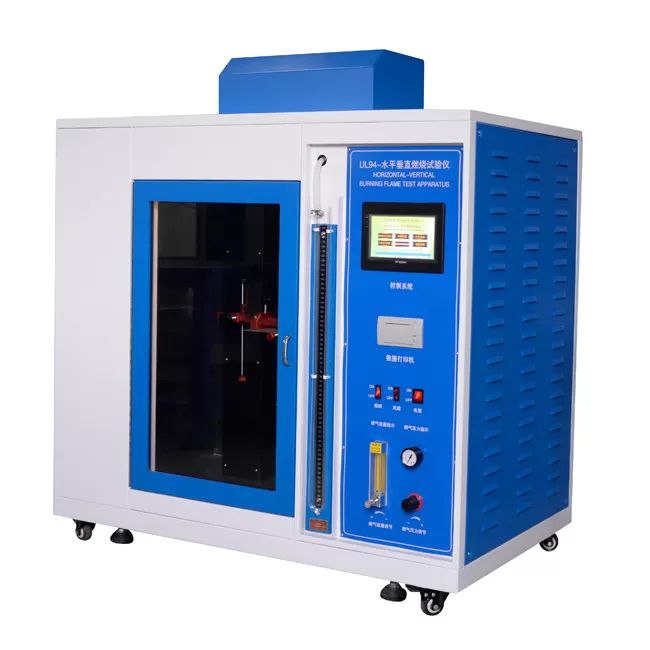
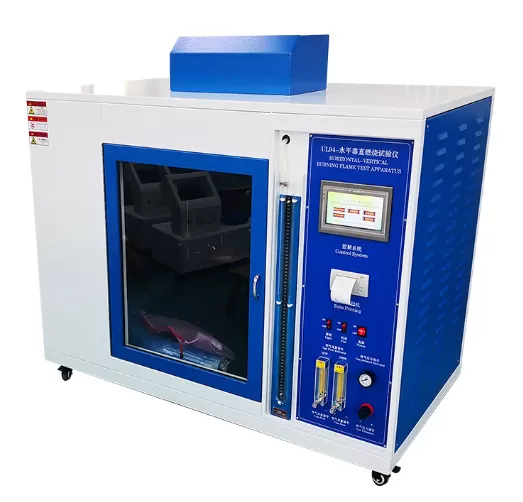
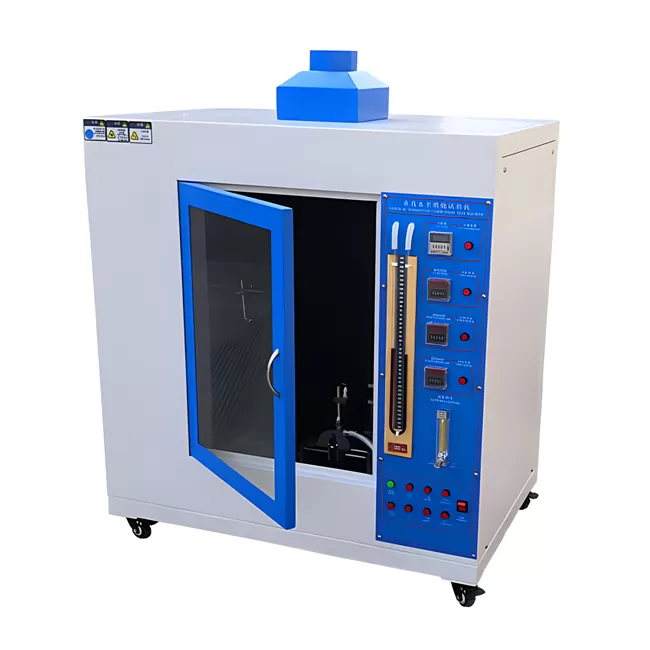
Bench-scale chambers provide a controlled environment for small specimens. They typically include a draft-free enclosure, specimen holder, adjustable ignition source, and exhaust connection. Some chambers support multiple test methods through interchangeable fixtures, which improves utilization and reduces the number of separate instruments a laboratory must maintain. Safety interlocks, door sensors, and gas shutoff valves are essential when tests involve methane, propane, or oxygen-enriched atmospheres.
Cone calorimeters are among the most information-rich fire testing instruments. By exposing a specimen to a calibrated radiant heat flux, they measure oxygen consumption, heat release, smoke obscuration, and mass loss. The resulting data supports material development, fire modeling, and regulatory submissions. Accurate calibration of the oxygen analyzer, heat flux meter, and load cell is central to reliable operation. Software must also handle baseline correction, drift compensation, and calculation of derived values such as peak heat release rate and total heat release.
Limiting oxygen index, often called LOI, is widely used for plastics, textiles, and composites. The test determines the minimum oxygen concentration in a nitrogen-oxygen mixture that sustains combustion. Precision gas mixing, stable flow control, and a consistent specimen holder are critical. Because LOI results are sensitive to specimen geometry and conditioning, laboratories benefit from standardized preparation procedures and environmental conditioning before testing.
Smoke generation is a major contributor to fire hazard, especially in enclosed spaces such as tunnels, rail cars, and buildings. Smoke density chambers measure light obscuration as a material burns or pyrolyzes. Toxicity systems go further by analyzing effluent gases for carbon monoxide, carbon dioxide, hydrogen cyanide, and other species. Glow-wire testers evaluate whether a heated wire can ignite a material or cause sustained burning. Each of these methods requires careful attention to chamber cleaning, sensor calibration, and exhaust handling.
Different industries prioritize different fire performance characteristics. A cable manufacturer may focus on flame spread and smoke release, while an aerospace supplier may need data on heat release and toxic gas emissions. Building material producers often require reaction-to-fire classifications, and automotive teams must address interior material flammability. The equipment portfolio should match the product roadmap, not just the current test request.
豪恩如何制造该设备
上述设备在东莞市豪恩自有厂区自主设计与制造,而非由外购部件组装而成。 这一区别对需要多台设备表现一致的实验室具有实际意义。
- 箱体几何结构、气流组织与保温层厚度在设计阶段确定,制板阶段固化
- 制冷系统选型、传感器布置与控制逻辑调试均在自有厂区完成
- 出厂前在自有校准平台完成校准并出具单台证书
- 随机质检档案可追溯至生产车间