Flammability Testing Machine Architecture: Lab Compliance & Fire Reaction Guide
Explore technical specifications, international standards, and calibration requirements for selecting an industrial-grade flammability testing machine.
Environmental Test Chamber Climate Test Chamber Salt Spray Test Chamber UV Aging Test Chamber Thermal Shock Test Chamber Dust Test Chamber Rain Test Chamber Boiling Test Chamber Dry Dehumidification Cabinet Xenon Test Chamber Universal Tensile Test Equipment Single Column Series Double Column Series Fixtures Drying Oven 200℃ Oven 300℃ Oven 400℃ Oven 500℃ Oven Vacuum Oven 27L Vacuum Oven 64L Vacuum Oven 125L Vacuum Oven 216L Vacuum Oven 512L Vacuum Oven 729L Vacuum Oven 1000L Vacuum Oven Two-box Vacuum Oven Three-box Vacuum Oven Vibration Shaker Table System Simulated Transportation Vibration Table Vertical Vibration Table Vertical Horizontal Vibration Table XYZ Three Axis Vibration Table Rubber And Plastic Test Equipment VICAT Tester Melt Flow Index Tester Flammability Test Equipment Charpy & Izod Impact Tester Paper Packaging Test Equipment Edge And Ring Crush Tester Drop Tester Carton Compression Tester Bursting Strength Tester Battery Test Equipment Videos About Us Our Partners & Clients Certifications & Honors Factory & Gallery Why Choose HAOEN Company Profile News Company News Industry News Contact 🇺🇸 English 🇫🇷 Français 🇩🇪 Deutsch 🇪🇸 Español .ml-sw{font-family:inherit;font-size:14px;line-height:1.5}.ml-dropdown{position:relative;display:inline-block;z-index:999}.ml-dd-trigger{display:flex;align-items:center;gap:6px;cursor:pointer;padding:4px 10px;border-radius:var(--ml-radius);color:var(--ml-text);transition:background .2s}.ml-dd-trigger:hover{background:rgba(0,0,0,.05)}.ml-dd-flag{font-size:18px}.ml-dd-icon{vertical-align:middle}.ml-dd-arrow{border:4px solid transparent;border-top:5px solid currentColor;margin-top:2px;transition:transform .2s}.ml-dropdown.open .ml-dd-arrow{transform:rotate(180deg)}.ml-dd-panel{display:none;position:absolute;top:100%;left:0;min-width:100%;width:max-content;background:var(--ml-bg);border-radius:var(--ml-radius);box-shadow:0 4px 16px rgba(0,0,0,.12);padding:4px 0;margin-top:4px}.ml-dropdown.open .ml-dd-panel{display:block}.ml-dd-item{display:flex;align-items:center;gap:8px;padding:8px 14px;color:var(--ml-text);text-decoration:none;transition:background .15s;white-space:nowrap}.ml-dd-item:hover{background:rgba(0,0,0,.04)}.ml-dd-item.active{color:var(--ml-primary);font-weight:500}.ml-dd-chk{margin-left:auto;font-size:12px}.ml-pills{display:flex;flex-wrap:nowrap;gap:6px;white-space:nowrap}.ml-pill{display:inline-flex;align-items:center;gap:4px;padding:4px 12px;border-radius:var(--ml-radius);background:var(--ml-bg);color:var(--ml-text);text-decoration:none;border:1px solid rgba(0,0,0,.1);transition:all .2s;font-size:13px;white-space:nowrap}.ml-pill:hover{border-color:var(--ml-primary);color:var(--ml-primary)}.ml-pill.active{background:var(--ml-primary);color:#fff;border-color:var(--ml-primary)}.ml-pill-flag{font-size:16px}.ml-bar{display:flex;gap:0;border-bottom:2px solid rgba(0,0,0,.06);white-space:nowrap}.ml-bar-item{display:inline-flex;align-items:center;gap:4px;padding:6px 14px;color:var(--ml-text);text-decoration:none;border-bottom:2px solid transparent;margin-bottom:-2px;transition:all .2s;font-size:13px;white-space:nowrap}.ml-bar-item:hover{color:var(--ml-primary)}.ml-bar-item.active{color:var(--ml-primary);border-bottom-color:var(--ml-primary);font-weight:500}.ml-bar-flag{font-size:16px}.ml-float{position:fixed;right:20px;bottom:20px;z-index:9999}.ml-float-btn{width:48px;height:48px;border-radius:50%;background:var(--ml-primary);color:#fff;border:none;cursor:pointer;box-shadow:0 4px 12px rgba(0,0,0,.2);transition:transform .2s;display:flex;align-items:center;justify-content:center;padding:0;line-height:1}.ml-float-btn:hover{transform:scale(1.1)}.ml-float-btn svg{width:24px;height:24px;display:block}.ml-float-panel{display:none;position:absolute;bottom:56px;right:0;min-width:160px;background:var(--ml-bg);border-radius:var(--ml-radius);box-shadow:0 4px 16px rgba(0,0,0,.12);padding:4px 0}.ml-float.open .ml-float-panel{display:block}.ml-float-item{display:flex;align-items:center;gap:8px;padding:8px 14px;color:var(--ml-text);text-decoration:none;transition:background .15s}.ml-float-item:hover{background:rgba(0,0,0,.04)}.ml-float-item.active{color:var(--ml-primary);font-weight:500}.ml-float-flag{font-size:18px} function mlSwToggle(){var e=document.getElementById("mlSw");if(e)e.classList.toggle("open")}document.addEventListener("click",function(e){var s=document.getElementById("mlSw");if(s&&!s.contains(e.target))s.classList.remove("open")}); News & Updates Stay informed with the latest industry news and company updates
News & Updates
News Industry News Industry News Flammability Testing Machine Architecture: Lab Compliance & Fire Reaction Guide 2026-09-03 Industry News 1 views Quantifying how materials behave under direct flame contact, radiant heat flux, and elevated thermal conditions is a non-negotiable requirement across global manufacturing. Polymers, structural composites, commercial textiles, and electronic encapsulants require documented reaction-to-fire characteristics before entering regulated supply chains. Deploying an industrial-grade flammability testing machine provides engineering teams and quality assurance laboratories with empirical data on ignitability, self-extinguishing capabilities, flame propagation rates, and secondary combustion phenomena such as flaming drips or post-ignition char development.
Thermal degradation begins at the chemical bond level, progressing through endothermic decomposition to produce volatile gaseous hydrocarbons. These combustible gases mix with ambient oxygen at the boundary layer, producing a self-sustaining exothermic chain reaction when an ignition source is introduced. Accurately characterizing this progression demands high-precision apparatus designed to isolate variables such as airflow velocity, thermal radiation intensity, exhaust evacuation rates, and gas composition. Navigating these requirements demands a precise technical understanding of instrument design, standardized test protocols, and operational workflows.
Regulatory Frameworks and Testing Methodologies Governing Reaction to Fire
Fire test standards do not assess a material under arbitrary conditions; instead, they define reproducible exposures ranging from low-energy Bunsen-style burners to elevated radiant thermal envelopes. Selecting laboratory instrumentation requires strict compatibility with specific standardization regimes established by ISO, ASTM, IEC, and regional safety organizations.
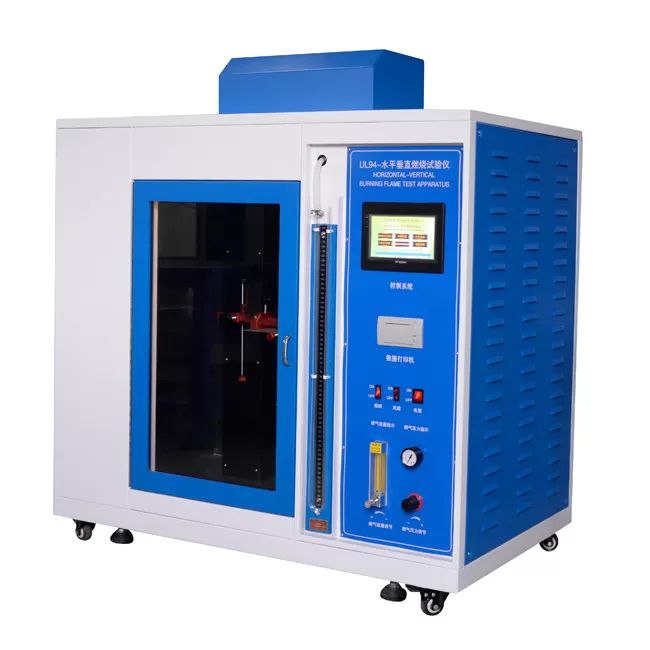
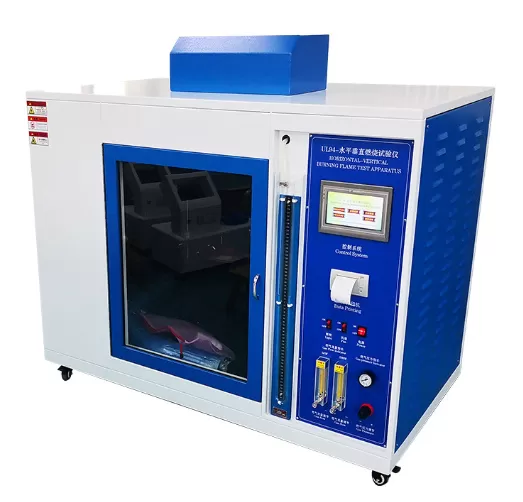
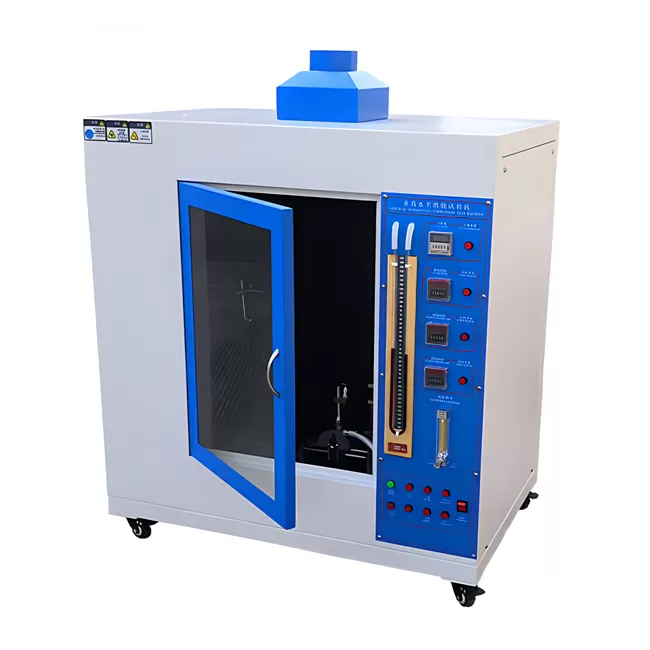
Vertical and Horizontal Bunsen Burner Tests: Governed by UL 94, ASTM D635, ASTM D3801, and IEC 60695-11-10. These methods determine burning rate, afterflame time, afterglow time, and whether molten polymers discharge burning particles capable of igniting surgical cotton situated beneath the specimen holder. Classifications range from HB (slow horizontal burn) through V-2, V-1, and V-0 (self-extinguishing vertical orientations), up to 5VA and 5VB ratings for industrial enclosures.
Core Engineering Principles Behind a Modern Flammability Testing Machine
Oxygen Index Determination: Standardized under ISO 4589-2 and ASTM D2863. This procedure establishes the Limiting Oxygen Index (LOI), which represents the minimum volumetric concentration of oxygen in a blended oxygen-nitrogen stream that supports flaming combustion of a vertically oriented test specimen.
Glow Wire and Hot Wire Ignition: Specified in IEC 60695-2-10 series for consumer electronics and domestic appliances. These tests simulate thermal stresses produced by malfunctioning electrical components, overloaded circuits, or glowing electrical contacts using an electrically heated nickel-chromium loop clamped against the test sample at temperatures up to 960 degrees Celsius.
Material Pyrolysis Dynamics Across Industry Sectors
Heat Release and Mass Loss Rate: Benchmarked through oxygen consumption calorimetry via ASTM E1354 and ISO 5660-1 (Cone Calorimeter). These standards quantify Peak Heat Release Rate (pHRR), Total Heat Release (THR), effective heat of combustion, and dynamic mass loss rate under uniform, user-specified external radiant heat fluxes reaching up to 100 kW per square meter.
Every operational flammability testing machine relies on an integrated assembly of fluid controls, thermal barriers, structural mechanics, and digital telemetry to guarantee measurement repeatability across hundreds of test cycles.
Technical Procurement Parameters for Quality Assurance and Testing Laboratories
The interior test enclosure must be fabricated from high-grade, corrosion-resistant austenitic stainless steel, typically AISI 304 or 316, or lined with non-combustible, asbestos-free insulation boards capable of withstanding repetitive thermal cycling. Natural draft or mechanically regulated ventilation systems ensure that ambient air delivers adequate stoichiometric oxygen to the combustion envelope without introducing micro-drafts that perturb the laminar profile of the application burner. Tempered, heat-resistant observation windows constructed from borosilicate glass allow operators to monitor flame spread and dripping events safely without disturbing chamber pressure or internal draft equilibria.
Precision flame application demands controlled exposure intervals down to the millisecond. Automated ignition systems drive certified Tirrill or Bunsen burners using motorized linear guide rails or pneumatic cylinders, ensuring zero manual variance during burner approach, dwell time, and withdrawal phases. The gas delivery train integrates digital mass flow controllers (MFCs) alongside needle valves to govern incoming fuel purity and flow velocity. Whether using methane, propane, or technical-grade butane, fuel flow rates must adhere strictly to standard-defined thermal output envelopes—typically verified by measuring the time required for a calibrated electrolytic copper block to heat through a defined temperature window.
Installation, Commissioning, and Environmental Controls
Advanced flammability testing rigs integrate thermopiles, high-resolution load cells, and water-cooled Schmidt-Boelter or Gardon-type heat flux gauges. When testing specimens in horizontal, vertical, or angled orientations, specialized pneumatic or screw-clamped jigs must securely restrain the substrate to avoid thermal warping, edge-curling, or unrepresentative premature structural collapse. Signal conditioning units digitize microvolt outputs from thermocouples positioned within the flame zone or exhaust plume, channeling high-frequency data streams into acquisition software for real-time visualization and reporting.
Fire risks manifest differently depending on polymer chemistry, cellular structure, physical geometry, and end-use environments. Evaluating testing machinery requires an understanding of how distinct classes of materials decompose under flame exposure.
Structural Thermoplastics and Engineering Resins: Polyamides (PA), polycarbonates (PC), and polybutylene terephthalate (PBT) used in automotive connectors and switchgear undergo thermal chain-scission. The presence of halogenated or phosphorus-based flame retardants stimulates vapor-phase radical quenching or promotes condensed-phase char forming. Instrumentation must capture afterflame intervals precisely to classify self-extinguishment.
Flexible and Rigid Cellular Plastics: Polyurethane and polystyrene foams frequently collapse, liquefy, or undergo severe volume retraction when exposed to heat sources. Testing these substrates per ASTM D3574 or ISO 3582 necessitates chambers that accommodate rapid smoke generation while preventing flame propagation along melted internal substrates.
Industrial and Transportation Textiles: Upholstery, geotextiles, and aviation cab interiors require both vertical strip flammability tests and 45-degree angle evaluations. Edge burning versus surface burning, fabric melting, and glowing smolder behavior demand optical sensors or mechanical tripwires linked directly to digital timers.
Wire, Cable, and Conduit Materials: Halogen-free flame retardant (HFFR) jackets and fluoropolymer insulation require vertical tray test rigs (e.g., IEC 60332 series). These assessments demand massive extraction capacity to handle substantial effluent generation alongside precise thermocouples arrayed over three-meter vertical risers.
豪恩如何制造该设备
上述设备在东莞市豪恩自有厂区自主设计与制造,而非由外购部件组装而成。 这一区别对需要多台设备表现一致的实验室具有实际意义。
- 箱体几何结构、气流组织与保温层厚度在设计阶段确定,制板阶段固化
- 制冷系统选型、传感器布置与控制逻辑调试均在自有厂区完成
- 出厂前在自有校准平台完成校准并出具单台证书
- 随机质检档案可追溯至生产车间