Engineering Guide to Xenon Testing: Accelerated Weathering, Protocols, and Standards
Master accelerated material durability with xenon testing. Learn spectral distribution, ASTM G155/ISO 4892 compliance, irradiance control, and chamber parameters.
Environmental Test Chamber Climate Test Chamber Salt Spray Test Chamber UV Aging Test Chamber Thermal Shock Test Chamber Dust Test Chamber Rain Test Chamber Boiling Test Chamber Dry Dehumidification Cabinet Xenon Test Chamber Universal Tensile Test Equipment Single Column Series Double Column Series Fixtures Drying Oven 200℃ Oven 300℃ Oven 400℃ Oven 500℃ Oven Vacuum Oven 27L Vacuum Oven 64L Vacuum Oven 125L Vacuum Oven 216L Vacuum Oven 512L Vacuum Oven 729L Vacuum Oven 1000L Vacuum Oven Two-box Vacuum Oven Three-box Vacuum Oven Vibration Shaker Table System Simulated Transportation Vibration Table Vertical Vibration Table Vertical Horizontal Vibration Table XYZ Three Axis Vibration Table Rubber And Plastic Test Equipment VICAT Tester Melt Flow Index Tester Flammability Test Equipment Charpy & Izod Impact Tester Paper Packaging Test Equipment Edge And Ring Crush Tester Drop Tester Carton Compression Tester Bursting Strength Tester Battery Test Equipment Videos About Us Our Partners & Clients Certifications & Honors Factory & Gallery Why Choose HAOEN Company Profile News Company News Industry News Contact 🇺🇸 English 🇫🇷 Français 🇩🇪 Deutsch 🇪🇸 Español .ml-sw{font-family:inherit;font-size:14px;line-height:1.5}.ml-dropdown{position:relative;display:inline-block;z-index:999}.ml-dd-trigger{display:flex;align-items:center;gap:6px;cursor:pointer;padding:4px 10px;border-radius:var(--ml-radius);color:var(--ml-text);transition:background .2s}.ml-dd-trigger:hover{background:rgba(0,0,0,.05)}.ml-dd-flag{font-size:18px}.ml-dd-icon{vertical-align:middle}.ml-dd-arrow{border:4px solid transparent;border-top:5px solid currentColor;margin-top:2px;transition:transform .2s}.ml-dropdown.open .ml-dd-arrow{transform:rotate(180deg)}.ml-dd-panel{display:none;position:absolute;top:100%;left:0;min-width:100%;width:max-content;background:var(--ml-bg);border-radius:var(--ml-radius);box-shadow:0 4px 16px rgba(0,0,0,.12);padding:4px 0;margin-top:4px}.ml-dropdown.open .ml-dd-panel{display:block}.ml-dd-item{display:flex;align-items:center;gap:8px;padding:8px 14px;color:var(--ml-text);text-decoration:none;transition:background .15s;white-space:nowrap}.ml-dd-item:hover{background:rgba(0,0,0,.04)}.ml-dd-item.active{color:var(--ml-primary);font-weight:500}.ml-dd-chk{margin-left:auto;font-size:12px}.ml-pills{display:flex;flex-wrap:nowrap;gap:6px;white-space:nowrap}.ml-pill{display:inline-flex;align-items:center;gap:4px;padding:4px 12px;border-radius:var(--ml-radius);background:var(--ml-bg);color:var(--ml-text);text-decoration:none;border:1px solid rgba(0,0,0,.1);transition:all .2s;font-size:13px;white-space:nowrap}.ml-pill:hover{border-color:var(--ml-primary);color:var(--ml-primary)}.ml-pill.active{background:var(--ml-primary);color:#fff;border-color:var(--ml-primary)}.ml-pill-flag{font-size:16px}.ml-bar{display:flex;gap:0;border-bottom:2px solid rgba(0,0,0,.06);white-space:nowrap}.ml-bar-item{display:inline-flex;align-items:center;gap:4px;padding:6px 14px;color:var(--ml-text);text-decoration:none;border-bottom:2px solid transparent;margin-bottom:-2px;transition:all .2s;font-size:13px;white-space:nowrap}.ml-bar-item:hover{color:var(--ml-primary)}.ml-bar-item.active{color:var(--ml-primary);border-bottom-color:var(--ml-primary);font-weight:500}.ml-bar-flag{font-size:16px}.ml-float{position:fixed;right:20px;bottom:20px;z-index:9999}.ml-float-btn{width:48px;height:48px;border-radius:50%;background:var(--ml-primary);color:#fff;border:none;cursor:pointer;box-shadow:0 4px 12px rgba(0,0,0,.2);transition:transform .2s;display:flex;align-items:center;justify-content:center;padding:0;line-height:1}.ml-float-btn:hover{transform:scale(1.1)}.ml-float-btn svg{width:24px;height:24px;display:block}.ml-float-panel{display:none;position:absolute;bottom:56px;right:0;min-width:160px;background:var(--ml-bg);border-radius:var(--ml-radius);box-shadow:0 4px 16px rgba(0,0,0,.12);padding:4px 0}.ml-float.open .ml-float-panel{display:block}.ml-float-item{display:flex;align-items:center;gap:8px;padding:8px 14px;color:var(--ml-text);text-decoration:none;transition:background .15s}.ml-float-item:hover{background:rgba(0,0,0,.04)}.ml-float-item.active{color:var(--ml-primary);font-weight:500}.ml-float-flag{font-size:18px} function mlSwToggle(){var e=document.getElementById("mlSw");if(e)e.classList.toggle("open")}document.addEventListener("click",function(e){var s=document.getElementById("mlSw");if(s&&!s.contains(e.target))s.classList.remove("open")}); News & Updates Stay informed with the latest industry news and company updates
News & Updates
News Industry News Industry News Engineering Guide to Xenon Testing: Accelerated Weathering, Protocols, and Standards 2026-10-08 Industry News 1 views Polymeric components, protective coatings, automotive textiles, and exterior building products experience continuous photolytic and photo-oxidative degradation under terrestrial sunlight. Ultraviolet radiation initiates polymer chain scission, while visible light and infrared radiation drive thermal degradation and thermal expansion stresses. To prevent premature field failure and quantify service life, research and quality assurance laboratories rely on xenon testing .
Xenon arc testing remains the industry standard for simulating natural sunlight exposure. Unlike fluorescent UV devices that reproduce only short-wavelength ultraviolet light, a filtered xenon arc lamp provides the closest laboratory simulation of the full solar spectrum, spanning the critical ultraviolet (UV), visible (VIS), and infrared (IR) ranges from 290 nm to 3000 nm.
The Photochemistry Behind Xenon Testing
Material breakdown under ambient outdoor exposure is rarely driven by a single environmental factor. Rather, degradation represents a synergistic reaction involving three primary stressors: light energy, thermal load, and moisture.
An unfiltered xenon burner emits substantial excess energy in both the extreme UV region (below 290 nm) and the infrared region (around 800–1000 nm). Because terrestrial sunlight at sea level has a natural cut-on wavelength around 290 nm, unfiltered xenon light induces uncharacteristic chemical reactions that never occur in real-world conditions.
Key Control Parameters: Achieving Reproducibility
To match specific service environments, optical filters adjust the raw spectral power distribution (SPD):
Photochemical degradation rates increase exponentially as surface temperature rises, following the Arrhenius relationship. Elevated surface temperatures accelerate free-radical propagation and mechanical plasticizer migration.
Global Standards Governing Xenon Testing
Moisture triggers physical and chemical degradation through direct hydrolysis, mechanical micro-cracking from thermal shock, and polymer swelling. Modern xenon testing reproduces moisture through programmed water spray cycles, humidity controls (20% to 98% RH), and dark condensation cycles.
Achieving repeatable test results across different laboratory runs requires closed-loop control of critical environmental metrics within the chamber.
Chamber Architecture: Engineering the Test Environment
Irradiance represents the rate at which light energy falls onto the test plane. Standard protocols mandate constant irradiance monitoring using closed-loop radiometer control at specific reference wavelengths:
Specimen surface temperatures run significantly higher than ambient chamber air temperatures due to radiative infrared absorption. Xenon arc chambers monitor this condition using specialized sensor plates:
Specimen Preparation, Run Execution, and Post-Test Metrology
Maintaining a set black panel temperature (e.g., 63°C ± 3°C or 70°C ± 2°C) while separately controlling Chamber Air Temperature (CAT) prevents divergent testing artifacts.
Engineers design durability testing matrices around recognized international standards to ensure contractual and regulatory compliance across global supply chains:
When implementing accelerated testing in an engineering workflow, selecting the proper chamber platform impacts specimen capacity, irradiance distribution, and thermal accuracy.
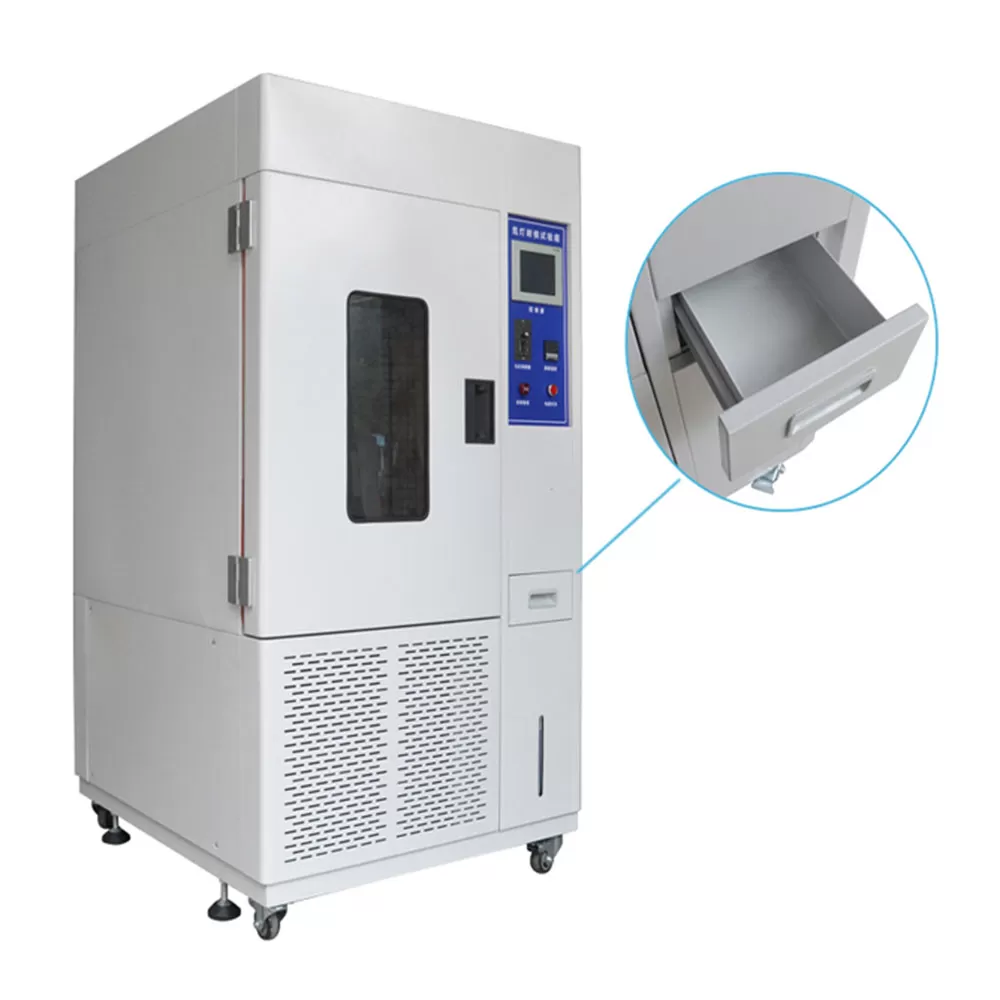
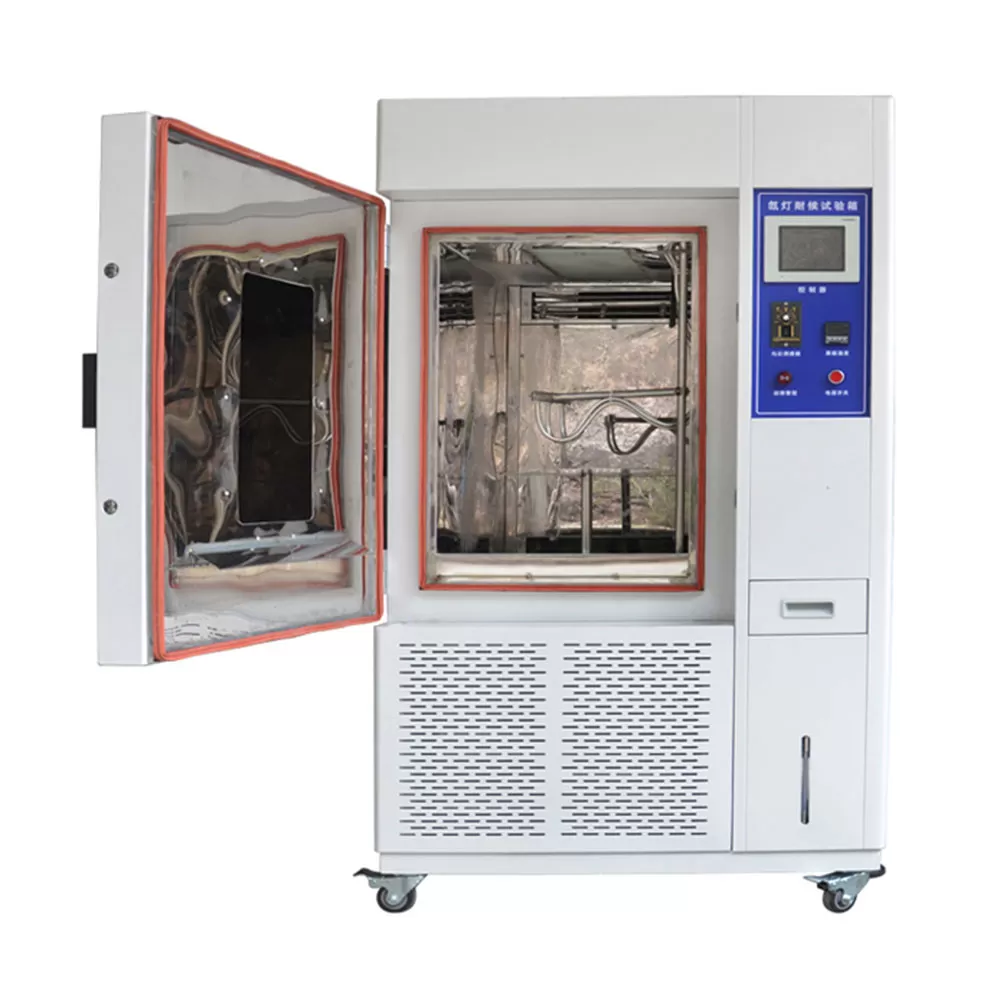
In high-precision xenon testing, non-uniform exposure causes false pass/fail conclusions. High-performance chambers mitigate this through dynamic exposure geometries. Equipment such as the HAOEN HE-XD Series utilizes a 360-degree rotating specimen carousel that turns around a centrally located xenon burner. This rotating configuration eliminates hot spots and ensures every sample receives uniform spectral irradiance and temperature distribution throughout prolonged testing cycles.
In contrast, flatbed (static) chambers position lamps above stationary horizontal trays. While static chambers accommodate three-dimensional, irregularly shaped components, rotating carousel systems deliver superior specimen-to-specimen uniformity for flat panels and standard coupon specimens.
Industrial testing chambers balance internal working volumes against facility capabilities. Below is an engineering overview of standard chamber configurations provided by HAOEN :
豪恩如何制造该设备
上述设备在东莞市豪恩自有厂区自主设计与制造,而非由外购部件组装而成。 这一区别对需要多台设备表现一致的实验室具有实际意义。
- 箱体几何结构、气流组织与保温层厚度在设计阶段确定,制板阶段固化
- 制冷系统选型、传感器布置与控制逻辑调试均在自有厂区完成
- 出厂前在自有校准平台完成校准并出具单台证书
- 随机质检档案可追溯至生产车间