Precision Flammability Test Chamber: Standards & Architecture
Explore the engineering, standards (UL 94, ISO 3795), and mechanical architecture of the modern flammability test chamber. Optimize your fire safety testing.
Environmental Test Chamber Climate Test Chamber Salt Spray Test Chamber UV Aging Test Chamber Thermal Shock Test Chamber Dust Test Chamber Rain Test Chamber Boiling Test Chamber Dry Dehumidification Cabinet Xenon Test Chamber Universal Tensile Test Equipment Single Column Series Double Column Series Fixtures Drying Oven 200℃ Oven 300℃ Oven 400℃ Oven 500℃ Oven Vacuum Oven 27L Vacuum Oven 64L Vacuum Oven 125L Vacuum Oven 216L Vacuum Oven 512L Vacuum Oven 729L Vacuum Oven 1000L Vacuum Oven Two-box Vacuum Oven Three-box Vacuum Oven Vibration Shaker Table System Simulated Transportation Vibration Table Vertical Vibration Table Vertical Horizontal Vibration Table XYZ Three Axis Vibration Table Rubber And Plastic Test Equipment VICAT Tester Melt Flow Index Tester Flammability Test Equipment Charpy & Izod Impact Tester Paper Packaging Test Equipment Edge And Ring Crush Tester Drop Tester Carton Compression Tester Bursting Strength Tester Battery Test Equipment Videos About Us Our Partners & Clients Certifications & Honors Factory & Gallery Why Choose HAOEN Company Profile News Company News Industry News Contact 🇺🇸 English 🇫🇷 Français 🇩🇪 Deutsch 🇪🇸 Español .ml-sw{font-family:inherit;font-size:14px;line-height:1.5}.ml-dropdown{position:relative;display:inline-block;z-index:999}.ml-dd-trigger{display:flex;align-items:center;gap:6px;cursor:pointer;padding:4px 10px;border-radius:var(--ml-radius);color:var(--ml-text);transition:background .2s}.ml-dd-trigger:hover{background:rgba(0,0,0,.05)}.ml-dd-flag{font-size:18px}.ml-dd-icon{vertical-align:middle}.ml-dd-arrow{border:4px solid transparent;border-top:5px solid currentColor;margin-top:2px;transition:transform .2s}.ml-dropdown.open .ml-dd-arrow{transform:rotate(180deg)}.ml-dd-panel{display:none;position:absolute;top:100%;left:0;min-width:100%;width:max-content;background:var(--ml-bg);border-radius:var(--ml-radius);box-shadow:0 4px 16px rgba(0,0,0,.12);padding:4px 0;margin-top:4px}.ml-dropdown.open .ml-dd-panel{display:block}.ml-dd-item{display:flex;align-items:center;gap:8px;padding:8px 14px;color:var(--ml-text);text-decoration:none;transition:background .15s;white-space:nowrap}.ml-dd-item:hover{background:rgba(0,0,0,.04)}.ml-dd-item.active{color:var(--ml-primary);font-weight:500}.ml-dd-chk{margin-left:auto;font-size:12px}.ml-pills{display:flex;flex-wrap:nowrap;gap:6px;white-space:nowrap}.ml-pill{display:inline-flex;align-items:center;gap:4px;padding:4px 12px;border-radius:var(--ml-radius);background:var(--ml-bg);color:var(--ml-text);text-decoration:none;border:1px solid rgba(0,0,0,.1);transition:all .2s;font-size:13px;white-space:nowrap}.ml-pill:hover{border-color:var(--ml-primary);color:var(--ml-primary)}.ml-pill.active{background:var(--ml-primary);color:#fff;border-color:var(--ml-primary)}.ml-pill-flag{font-size:16px}.ml-bar{display:flex;gap:0;border-bottom:2px solid rgba(0,0,0,.06);white-space:nowrap}.ml-bar-item{display:inline-flex;align-items:center;gap:4px;padding:6px 14px;color:var(--ml-text);text-decoration:none;border-bottom:2px solid transparent;margin-bottom:-2px;transition:all .2s;font-size:13px;white-space:nowrap}.ml-bar-item:hover{color:var(--ml-primary)}.ml-bar-item.active{color:var(--ml-primary);border-bottom-color:var(--ml-primary);font-weight:500}.ml-bar-flag{font-size:16px}.ml-float{position:fixed;right:20px;bottom:20px;z-index:9999}.ml-float-btn{width:48px;height:48px;border-radius:50%;background:var(--ml-primary);color:#fff;border:none;cursor:pointer;box-shadow:0 4px 12px rgba(0,0,0,.2);transition:transform .2s;display:flex;align-items:center;justify-content:center;padding:0;line-height:1}.ml-float-btn:hover{transform:scale(1.1)}.ml-float-btn svg{width:24px;height:24px;display:block}.ml-float-panel{display:none;position:absolute;bottom:56px;right:0;min-width:160px;background:var(--ml-bg);border-radius:var(--ml-radius);box-shadow:0 4px 16px rgba(0,0,0,.12);padding:4px 0}.ml-float.open .ml-float-panel{display:block}.ml-float-item{display:flex;align-items:center;gap:8px;padding:8px 14px;color:var(--ml-text);text-decoration:none;transition:background .15s}.ml-float-item:hover{background:rgba(0,0,0,.04)}.ml-float-item.active{color:var(--ml-primary);font-weight:500}.ml-float-flag{font-size:18px} function mlSwToggle(){var e=document.getElementById("mlSw");if(e)e.classList.toggle("open")}document.addEventListener("click",function(e){var s=document.getElementById("mlSw");if(s&&!s.contains(e.target))s.classList.remove("open")}); News & Updates Stay informed with the latest industry news and company updates
Thermodynamics of Flame Propagation and Material Thermal Degradation
News Industry News Industry News Precision Flammability Test Chamber: Standards & Architecture 2026-09-05 Industry News 1 views Polymeric formulations, textile composites, and electrical enclosures undergo intense thermal stress in real-world applications. When organic polymers encounter an ignition source, heat initiates an irreversible cascade of pyrolysis, producing volatile gases, char, and reactive free radicals. Quantifying this behavior requires exact environmental isolation, reproducible ignition energy, and high-precision temporal tracking. The flammability test chamber serves as the primary instrument for standardizing these physical phenomena, translating chaotic combustion events into empirical, repeatable data points.
Deploying reliable bench-scale fire testing requires an understanding of thermodynamics, fluid dynamics, and international test standards. Materials that exhibit self-extinguishing behavior under ambient laboratory conditions can demonstrate rapid flame propagation when exposed to controlled thermal fluxes or altered ventilation paths. Consequently, testing hardware must isolate the specimen from uncontrolled air currents, regulate fuel-to-air ratios with absolute fidelity, and ensure that physical degradation does not skew the resulting metrics.
Global Regulatory Protocols and Test Standards
Solid-phase combustion begins when external thermal energy exceeds the dissociation energy of covalent bonds within the polymer backbone. As the surface temperature rises past the decomposition threshold, the polymer breaks down into lower molecular weight fragments. These combustible volatiles escape into the boundary layer directly above the specimen surface, mixing with atmospheric oxygen. Once this gas mixture reaches its flammability limit and ignition temperature, combustion initiates in the gas phase.
The flammability test chamber evaluates materials across distinct stages of this progression:
Critical Hardware Subsystems in a Flammability Test Chamber
Ignition Latency: The exact duration of flame exposure required to generate an autonomous, self-sustaining gas-phase flame.
Specimen Preparation Protocols and Operational Repeatability
Afterflame Time (t1 and t2): The duration over which the material continues to support flaming combustion after the primary ignition source has been retracted.
Overcoming Technical Bottlenecks in Flammability Testing
Afterglow Time (t3): The period of flameless, glowing combustion sustained within the carbonaceous char layer via solid-phase oxidation.
Hardware Selection Criteria for Industrial Laboratories
Dripping Phenomena: The separation of molten, flaming droplets capable of igniting secondary substrates placed beneath the primary burn zone.
Key considerations for laboratory teams
Managing these variables depends on maintaining stable atmospheric oxygen levels throughout the burn phase. A properly calibrated combustion enclosure maintains sufficient air volume to prevent oxygen starvation while precluding forced convection currents that accelerate heat dissipation away from the flame zone.
Standardized methodologies dictate mechanical configurations, burner geometries, and data capture criteria. Different industries demand distinct combustion orientations, reflecting the orientation of components in their final operational environments.
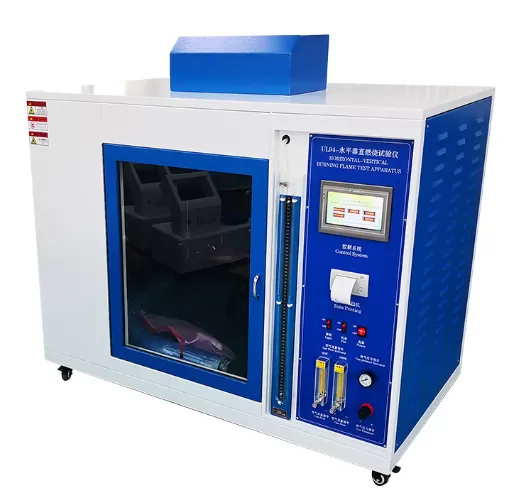
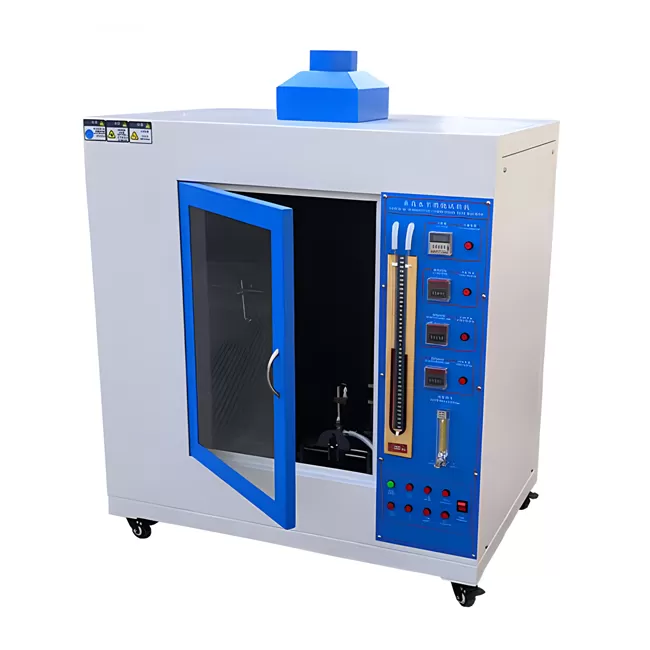
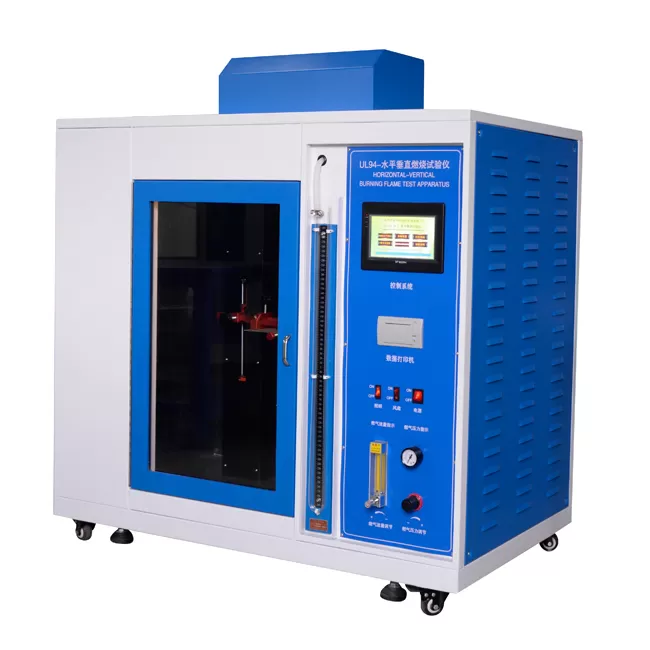
UL 94 defines the industry benchmark for devices and appliances. The standard outlines horizontal burning (HB) and vertical burning (V-0, V-1, V-2) classifications, with higher-tier tests utilizing the 5V (5VA, 5VB) protocols. In a vertical configuration, a calibrated Bunsen burner introduces a standardized methane flame (typically 20 mm to 125 mm height) to the bottom edge of a bar specimen for specified intervals, such as two 10-second applications. Classification rests not only on the flame extinguishing time but also on whether burning particulates ignite surgical cotton positioned 300 mm below the clamp.
Governing electronics, consumer goods, and electrical switchgear, IEC 60695 evaluates how components react to thermal stresses mimicking electrical faults. Methods include the Needle Flame Test (IEC 60695-11-5), which simulates localized micro-flames originating from overheated traces or PCB components, and the Glow-Wire Test (IEC 60695-2-10 to 13), where an electrically heated nickel-chromium loop applies direct conductive heat to assess flammability and ignition indices without open flame exposure.
How HAOEN builds this equipment
The chamber described above is designed and manufactured in HAOEN's own plants in Dongguan, rather than assembled from purchased sub-assemblies. That distinction matters when a lab needs repeatable performance across a fleet of machines.
- Chamber geometry, airflow and insulation are engineered in-house and issued as controlled drawings
- Steel is cut, bent and welded on our own line, with stress relief and surface treatment between stages
- Refrigeration, electrical cabinets and sensor harnesses are installed and wired by our own technicians
- Each unit runs a full commissioning cycle with logged test data before the QC file is signed
- Export crating, anti-rust treatment and the complete document set are prepared in-house
Because engineering, production and calibration sit under the same roof, specification changes during a project are absorbed by the factory rather than passed between suppliers. Standard units follow the same route, which is why a catalogue model and a custom-built chamber carry the same documentation discipline.