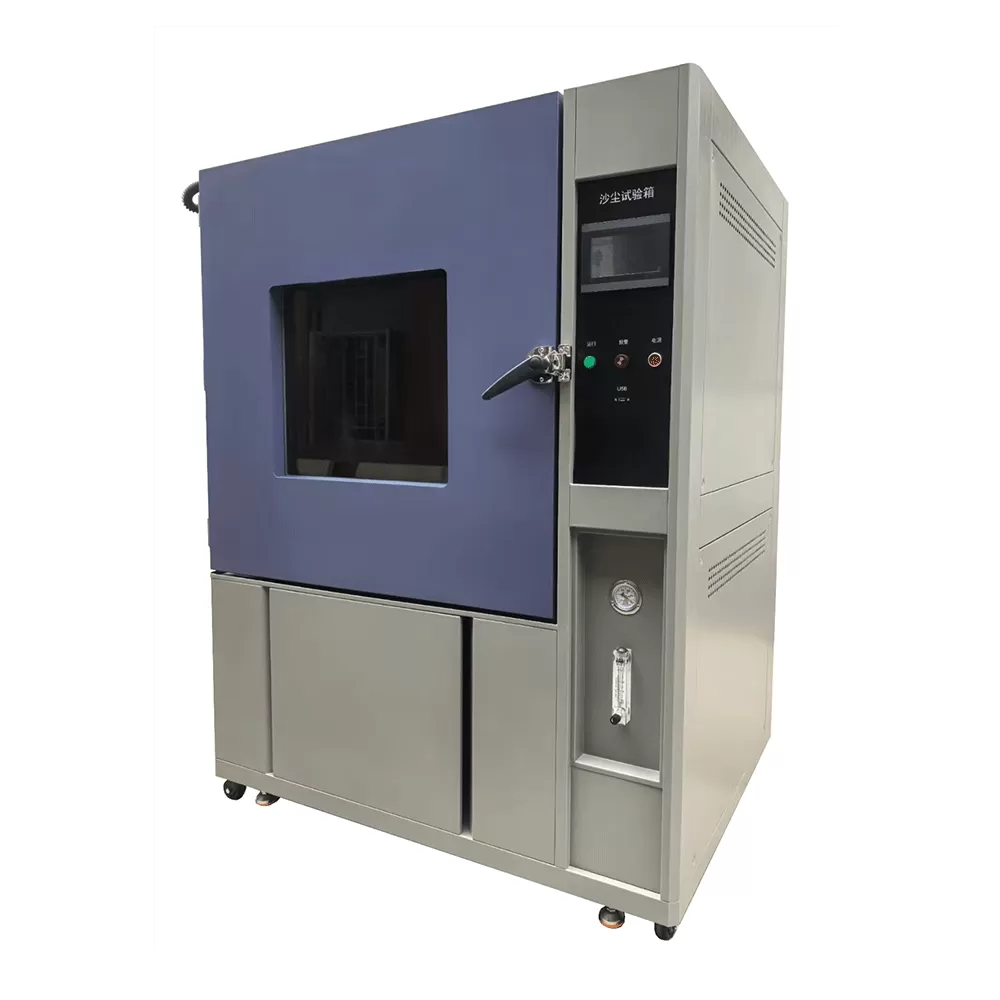
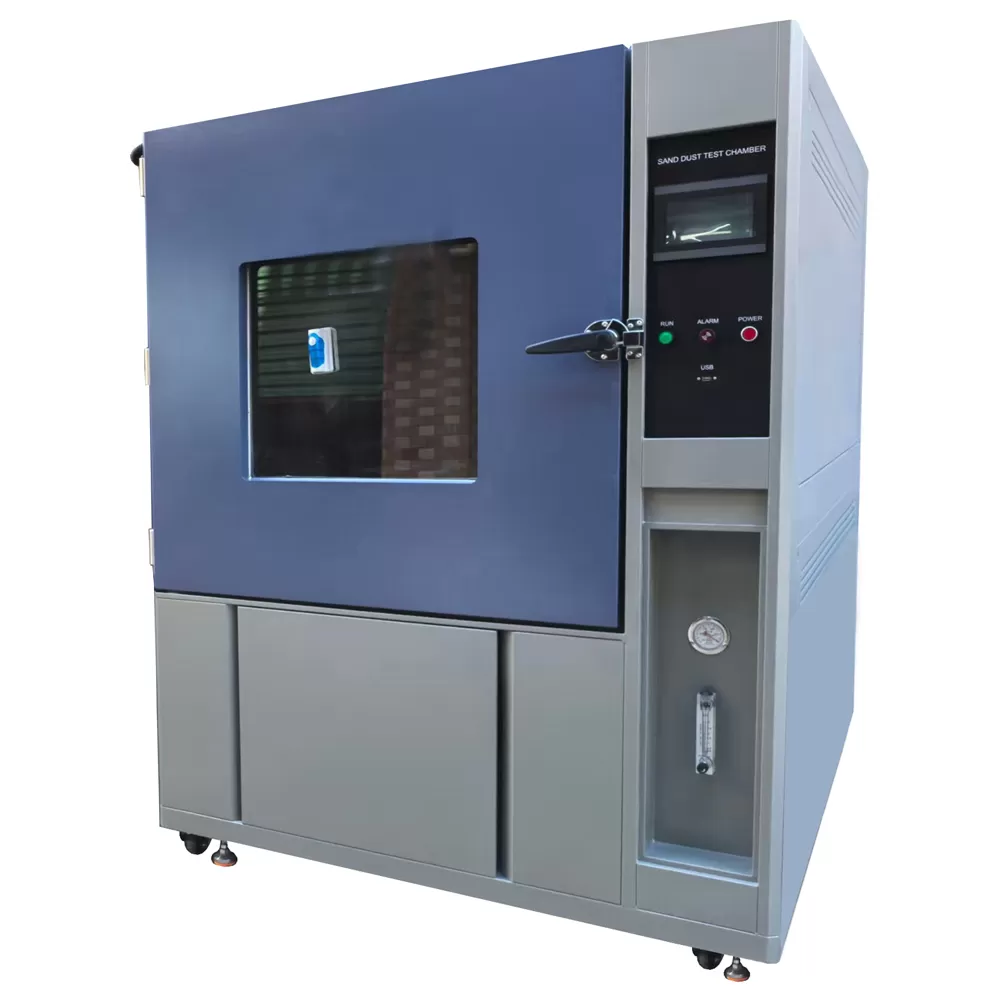
How a Dust Chamber Validates IP5X/IP6X Sealing Performance
Explore how a dust chamber validates IP5X and IP6X ingress protection, with technical detail on airflow, talcum feed, vacuum control, and test standards.
Environmental Test Chamber Climate Test Chamber Salt Spray Test Chamber UV Aging Test Chamber Thermal Shock Test Chamber Dust Test Chamber Rain Test Chamber Boiling Test Chamber Dry Dehumidification Cabinet Xenon Test Chamber Universal Tensile Test Equipment Single Column Series Double Column Series Fixtures Drying Oven 200℃ Oven 300℃ Oven 400℃ Oven 500℃ Oven Vacuum Oven 27L Vacuum Oven 64L Vacuum Oven 125L Vacuum Oven 216L Vacuum Oven 512L Vacuum Oven 729L Vacuum Oven 1000L Vacuum Oven Two-box Vacuum Oven Three-box Vacuum Oven Vibration Shaker Table System Simulated Transportation Vibration Table Vertical Vibration Table Vertical Horizontal Vibration Table XYZ Three Axis Vibration Table Rubber And Plastic Test Equipment VICAT Tester Melt Flow Index Tester Flammability Test Equipment Charpy & Izod Impact Tester Paper Packaging Test Equipment Edge And Ring Crush Tester Drop Tester Carton Compression Tester Bursting Strength Tester Battery Test Equipment Videos About Us Our Partners & Clients Certifications & Honors Factory & Gallery Why Choose HAOEN Company Profile News Company News Industry News Contact 🇺🇸 English 🇫🇷 Français 🇩🇪 Deutsch 🇪🇸 Español .ml-sw{font-family:inherit;font-size:14px;line-height:1.5}.ml-dropdown{position:relative;display:inline-block;z-index:999}.ml-dd-trigger{display:flex;align-items:center;gap:6px;cursor:pointer;padding:4px 10px;border-radius:var(--ml-radius);color:var(--ml-text);transition:background .2s}.ml-dd-trigger:hover{background:rgba(0,0,0,.05)}.ml-dd-flag{font-size:18px}.ml-dd-icon{vertical-align:middle}.ml-dd-arrow{border:4px solid transparent;border-top:5px solid currentColor;margin-top:2px;transition:transform .2s}.ml-dropdown.open .ml-dd-arrow{transform:rotate(180deg)}.ml-dd-panel{display:none;position:absolute;top:100%;left:0;min-width:100%;width:max-content;background:var(--ml-bg);border-radius:var(--ml-radius);box-shadow:0 4px 16px rgba(0,0,0,.12);padding:4px 0;margin-top:4px}.ml-dropdown.open .ml-dd-panel{display:block}.ml-dd-item{display:flex;align-items:center;gap:8px;padding:8px 14px;color:var(--ml-text);text-decoration:none;transition:background .15s;white-space:nowrap}.ml-dd-item:hover{background:rgba(0,0,0,.04)}.ml-dd-item.active{color:var(--ml-primary);font-weight:500}.ml-dd-chk{margin-left:auto;font-size:12px}.ml-pills{display:flex;flex-wrap:nowrap;gap:6px;white-space:nowrap}.ml-pill{display:inline-flex;align-items:center;gap:4px;padding:4px 12px;border-radius:var(--ml-radius);background:var(--ml-bg);color:var(--ml-text);text-decoration:none;border:1px solid rgba(0,0,0,.1);transition:all .2s;font-size:13px;white-space:nowrap}.ml-pill:hover{border-color:var(--ml-primary);color:var(--ml-primary)}.ml-pill.active{background:var(--ml-primary);color:#fff;border-color:var(--ml-primary)}.ml-pill-flag{font-size:16px}.ml-bar{display:flex;gap:0;border-bottom:2px solid rgba(0,0,0,.06);white-space:nowrap}.ml-bar-item{display:inline-flex;align-items:center;gap:4px;padding:6px 14px;color:var(--ml-text);text-decoration:none;border-bottom:2px solid transparent;margin-bottom:-2px;transition:all .2s;font-size:13px;white-space:nowrap}.ml-bar-item:hover{color:var(--ml-primary)}.ml-bar-item.active{color:var(--ml-primary);border-bottom-color:var(--ml-primary);font-weight:500}.ml-bar-flag{font-size:16px}.ml-float{position:fixed;right:20px;bottom:20px;z-index:9999}.ml-float-btn{width:48px;height:48px;border-radius:50%;background:var(--ml-primary);color:#fff;border:none;cursor:pointer;box-shadow:0 4px 12px rgba(0,0,0,.2);transition:transform .2s;display:flex;align-items:center;justify-content:center;padding:0;line-height:1}.ml-float-btn:hover{transform:scale(1.1)}.ml-float-btn svg{width:24px;height:24px;display:block}.ml-float-panel{display:none;position:absolute;bottom:56px;right:0;min-width:160px;background:var(--ml-bg);border-radius:var(--ml-radius);box-shadow:0 4px 16px rgba(0,0,0,.12);padding:4px 0}.ml-float.open .ml-float-panel{display:block}.ml-float-item{display:flex;align-items:center;gap:8px;padding:8px 14px;color:var(--ml-text);text-decoration:none;transition:background .15s}.ml-float-item:hover{background:rgba(0,0,0,.04)}.ml-float-item.active{color:var(--ml-primary);font-weight:500}.ml-float-flag{font-size:18px} function mlSwToggle(){var e=document.getElementById("mlSw");if(e)e.classList.toggle("open")}document.addEventListener("click",function(e){var s=document.getElementById("mlSw");if(s&&!s.contains(e.target))s.classList.remove("open")}); News & Updates Stay informed with the latest industry news and company updates
What a Dust Chamber Actually Reproduces
News Industry News Industry News How a Dust Chamber Validates IP5X/IP6X Sealing Performance 2026-09-16 Industry News 1 views Particulate ingress remains one of the least forgiving failure modes in outdoor electronics, automotive lighting, connector assemblies, and photovoltaic hardware. A single grain of fine mineral dust reaching a bearing surface or a sealed contact can change electrical behavior and mechanical wear over a product's service life. Because field exposure takes years to produce measurable results, engineering teams reproduce the process in a dust chamber where concentration, airflow, humidity, and pressure differential can be held to defined values.
Dust ingress is not a single mechanism. Particles settle under gravity, travel on air currents, migrate through pressure-driven leaks, and accumulate around gaskets and cable entries. Thermal cycling opens and closes microscopic gaps, while vibration works abrasive material into seams. An effective test system therefore has to control several physical variables at once rather than simply filling a cabinet with powder.
Standards That Define Chamber Test Parameters
Two operating modes dominate laboratory practice. Free-settling exposure suspends powder gently and allows it to descend onto the sample, which reflects installations such as roadside cabinets and rooftop enclosures. Circulating exposure keeps dust airborne with blowers or injection nozzles so the sample faces continuous particle impingement, reproducing vehicles, turbines, and equipment mounted near moving air. Some chambers support only one mode, while configurable platforms switch between them.
The particle specification matters as much as the mode. Fine talcum powder behaves very differently from coarse sand or from blended test dusts such as Arizona Test Dust, red kaolin, or silica flour. Particle size distribution, moisture content, and angularity all affect how material penetrates a gasket and how it settles inside the chamber. Treating every powder as interchangeable produces data that cannot be compared across laboratories or repeated across production batches.
Technical Anatomy of a Reliable Dust Chamber
Test parameters come from product standards, not from chamber design preferences. The equipment must be able to hold whatever the referenced document demands, which is why specification review comes before dust chamber selection.
Selection Criteria and Operational Challenges
That vacuum requirement is where many facilities fall short. Without calibrated, independent extraction control per test item, the pressure differential drifts, and the resulting test does not represent the rating being claimed.
Maintenance, Verification, and Lifecycle Planning
ISO 20653 adapts the IP framework for road vehicles and defines dust classes that reflect under-hood and exterior mounting positions. MIL-STD-810 Method 510 covers blowing dust and settling dust procedures with defined dust concentration, wind velocity, and duration values, and is common for defense and ruggedized equipment. RTCA DO-160 Section 12 addresses airborne avionics, where fine dust combined with altitude-related pressure changes produces demanding conditions.
Frequently Asked Questions
This standard group separates test L into variants covering airborne dust and sand, free settling dust, and high-velocity sand-laden airflow. Chambers intended for these methods need adjustable airflow velocity and, in some configurations, temperature control to match the referenced profile.
Key considerations for laboratory teams
Mechanical construction decides whether a chamber produces repeatable data or merely plausible-looking results. Four subsystems carry most of the responsibility.
Internal volume has to be sized around the sample, its fixture, and the required clearance for airflow. Sharp corners and structural ledges create dead zones where powder accumulates instead of circulating. A well-designed chamber uses radiused internal surfaces, a dedicated return duct, and a diffuser that distributes air across the full working section. Computational fluid dynamics modeling during design confirms that velocity and concentration remain within tolerance across the usable volume rather than only near the injection point.
Stainless steel 304 or 316 interior for corrosion resistance and easy cleaning
Interlocked door and safety logic to prevent powder release during operation
How HAOEN builds this equipment
The chamber described above is designed and manufactured in HAOEN's own plants in Dongguan, rather than assembled from purchased sub-assemblies. That distinction matters when a lab needs repeatable performance across a fleet of machines.
- Chamber geometry, airflow and insulation are engineered in-house and issued as controlled drawings
- Steel is cut, bent and welded on our own line, with stress relief and surface treatment between stages
- Refrigeration, electrical cabinets and sensor harnesses are installed and wired by our own technicians
- Each unit runs a full commissioning cycle with logged test data before the QC file is signed
- Export crating, anti-rust treatment and the complete document set are prepared in-house
Because engineering, production and calibration sit under the same roof, specification changes during a project are absorbed by the factory rather than passed between suppliers. Standard units follow the same route, which is why a catalogue model and a custom-built chamber carry the same documentation discipline.