How to Choose a Paper Testing Machine for ISO and TAPPI Compliance?
Discover how high-precision paper testing instrumentation measures tensile, burst, and compressive properties to ensure ISO/TAPPI standard compliance in packaging.
Environmental Test Chamber Climate Test Chamber Salt Spray Test Chamber UV Aging Test Chamber Thermal Shock Test Chamber Dust Test Chamber Rain Test Chamber Boiling Test Chamber Dry Dehumidification Cabinet Xenon Test Chamber Universal Tensile Test Equipment Single Column Series Double Column Series Fixtures Drying Oven 200℃ Oven 300℃ Oven 400℃ Oven 500℃ Oven Vacuum Oven 27L Vacuum Oven 64L Vacuum Oven 125L Vacuum Oven 216L Vacuum Oven 512L Vacuum Oven 729L Vacuum Oven 1000L Vacuum Oven Two-box Vacuum Oven Three-box Vacuum Oven Vibration Shaker Table System Simulated Transportation Vibration Table Vertical Vibration Table Vertical Horizontal Vibration Table XYZ Three Axis Vibration Table Rubber And Plastic Test Equipment VICAT Tester Melt Flow Index Tester Flammability Test Equipment Charpy & Izod Impact Tester Paper Packaging Test Equipment Edge And Ring Crush Tester Drop Tester Carton Compression Tester Bursting Strength Tester Battery Test Equipment Videos About Us Our Partners & Clients Certifications & Honors Factory & Gallery Why Choose HAOEN Company Profile News Company News Industry News Contact 🇺🇸 English 🇫🇷 Français 🇩🇪 Deutsch 🇪🇸 Español .ml-sw{font-family:inherit;font-size:14px;line-height:1.5}.ml-dropdown{position:relative;display:inline-block;z-index:999}.ml-dd-trigger{display:flex;align-items:center;gap:6px;cursor:pointer;padding:4px 10px;border-radius:var(--ml-radius);color:var(--ml-text);transition:background .2s}.ml-dd-trigger:hover{background:rgba(0,0,0,.05)}.ml-dd-flag{font-size:18px}.ml-dd-icon{vertical-align:middle}.ml-dd-arrow{border:4px solid transparent;border-top:5px solid currentColor;margin-top:2px;transition:transform .2s}.ml-dropdown.open .ml-dd-arrow{transform:rotate(180deg)}.ml-dd-panel{display:none;position:absolute;top:100%;left:0;min-width:100%;width:max-content;background:var(--ml-bg);border-radius:var(--ml-radius);box-shadow:0 4px 16px rgba(0,0,0,.12);padding:4px 0;margin-top:4px}.ml-dropdown.open .ml-dd-panel{display:block}.ml-dd-item{display:flex;align-items:center;gap:8px;padding:8px 14px;color:var(--ml-text);text-decoration:none;transition:background .15s;white-space:nowrap}.ml-dd-item:hover{background:rgba(0,0,0,.04)}.ml-dd-item.active{color:var(--ml-primary);font-weight:500}.ml-dd-chk{margin-left:auto;font-size:12px}.ml-pills{display:flex;flex-wrap:nowrap;gap:6px;white-space:nowrap}.ml-pill{display:inline-flex;align-items:center;gap:4px;padding:4px 12px;border-radius:var(--ml-radius);background:var(--ml-bg);color:var(--ml-text);text-decoration:none;border:1px solid rgba(0,0,0,.1);transition:all .2s;font-size:13px;white-space:nowrap}.ml-pill:hover{border-color:var(--ml-primary);color:var(--ml-primary)}.ml-pill.active{background:var(--ml-primary);color:#fff;border-color:var(--ml-primary)}.ml-pill-flag{font-size:16px}.ml-bar{display:flex;gap:0;border-bottom:2px solid rgba(0,0,0,.06);white-space:nowrap}.ml-bar-item{display:inline-flex;align-items:center;gap:4px;padding:6px 14px;color:var(--ml-text);text-decoration:none;border-bottom:2px solid transparent;margin-bottom:-2px;transition:all .2s;font-size:13px;white-space:nowrap}.ml-bar-item:hover{color:var(--ml-primary)}.ml-bar-item.active{color:var(--ml-primary);border-bottom-color:var(--ml-primary);font-weight:500}.ml-bar-flag{font-size:16px}.ml-float{position:fixed;right:20px;bottom:20px;z-index:9999}.ml-float-btn{width:48px;height:48px;border-radius:50%;background:var(--ml-primary);color:#fff;border:none;cursor:pointer;box-shadow:0 4px 12px rgba(0,0,0,.2);transition:transform .2s;display:flex;align-items:center;justify-content:center;padding:0;line-height:1}.ml-float-btn:hover{transform:scale(1.1)}.ml-float-btn svg{width:24px;height:24px;display:block}.ml-float-panel{display:none;position:absolute;bottom:56px;right:0;min-width:160px;background:var(--ml-bg);border-radius:var(--ml-radius);box-shadow:0 4px 16px rgba(0,0,0,.12);padding:4px 0}.ml-float.open .ml-float-panel{display:block}.ml-float-item{display:flex;align-items:center;gap:8px;padding:8px 14px;color:var(--ml-text);text-decoration:none;transition:background .15s}.ml-float-item:hover{background:rgba(0,0,0,.04)}.ml-float-item.active{color:var(--ml-primary);font-weight:500}.ml-float-flag{font-size:18px} function mlSwToggle(){var e=document.getElementById("mlSw");if(e)e.classList.toggle("open")}document.addEventListener("click",function(e){var s=document.getElementById("mlSw");if(s&&!s.contains(e.target))s.classList.remove("open")}); News & Updates Stay informed with the latest industry news and company updates
Mechanical Metrics in Paper Physical Property Evaluation
News Industry News Industry News How to Choose a Paper Testing Machine for ISO and TAPPI Compliance? 2026-08-08 Industry News 1 views Paper and paperboard materials undergo severe mechanical stress during processing, converting, and final distribution. Industrial packaging suppliers, paper mills, and converting operations require absolute quantitative verification of fiber strength, ply bonding, absorbency, and structural resistance. A high-precision paper testing machine serves as the foundation for modern quality control, enabling manufacturers to characterize material performance against rigorous global standards.
Substandard paper quality leads to box crushing, joint failures, feed jams on high-speed converting lines, and compromised moisture barrier performance. By applying precise physical forces under controlled laboratory environments, modern testing instrumentation translates complex polymeric fiber interactions into standardized, actionable metrics. Understanding the mechanical architecture, measurement protocols, and standards governing these instruments is necessary for establishing repeatable production outcomes.
Application Matrix Across Converting and Packaging Sectors
Determining the mechanical capability of paper involves evaluating structural performance under tensile, compressive, hydraulic, and surface-level stress vectors. Each physical parameter correlates directly with raw material fiber length, refining intensity, binder distribution, and web orientation.
Tensile performance defines the force required to rupture a specimen strip under uniaxial load. Testing adheres to standardized frameworks such as ISO 1924 and TAPPI T 494, which mandate a Constant Rate of Elongation (CRE) load frame. Key parameters extracted during this process include:
Mechanical Architecture and Data Acquisition Standards
Tensile Strength: The maximum tensile force per unit width recorded prior to material rupture, expressed in kilonewtons per meter (kN/m).
Methodological Analysis for Testing Discrepancies
Break Elongation: The percentage increase in specimen length achieved at the point of fracture, reflecting the elasticity imparted by fiber micro-creping and inter-fiber bonding.
Selecting Equipment for Laboratory and Line-Side Testing
Tensile Stiffness Index: The maximum slope of the stress-strain curve normalized by basis weight, indicating structural resistance to elastic deformation.
Frequently Asked Questions
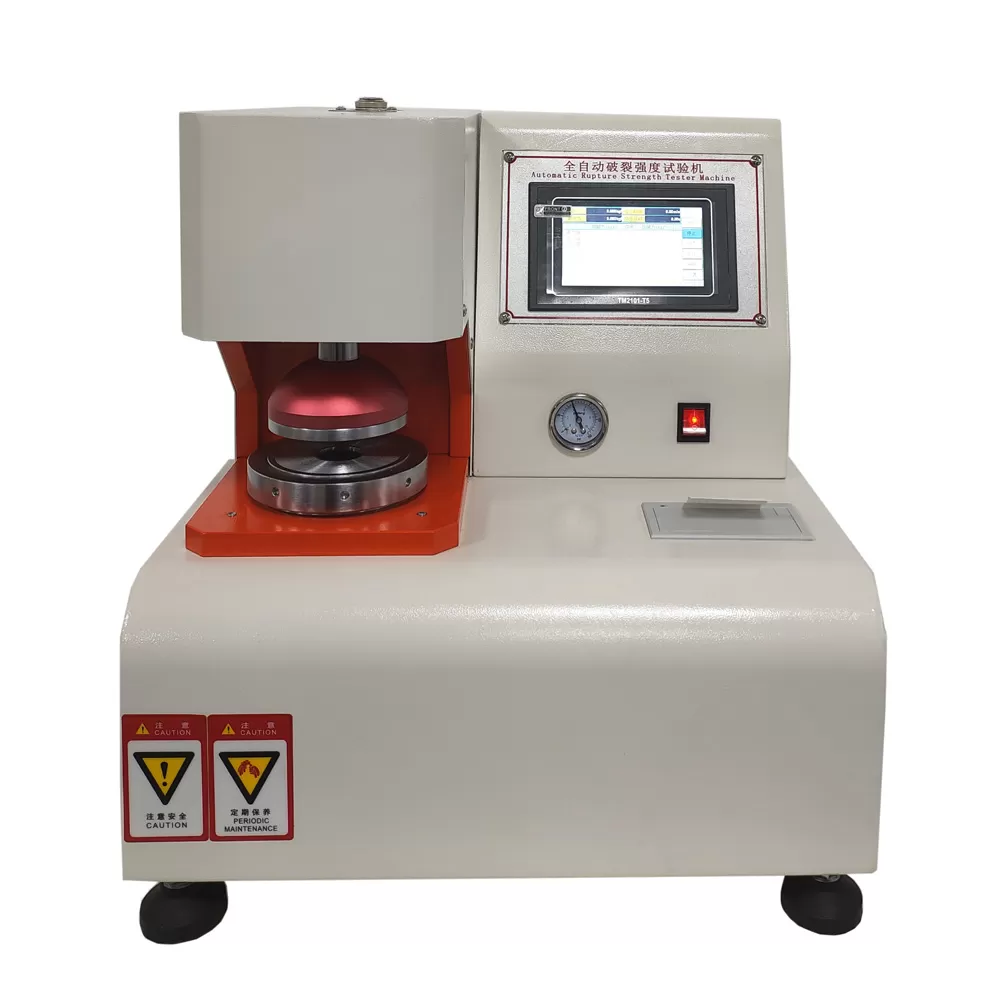
Burst strength measures a sheet’s multidirectional resistance to rupture under increasing hydraulic pressure. Regulated by ISO 2758 for paper and ISO 2759 for paperboard, this metric simulates multidirectional stresses encountered when bulk contents push against container walls.
Key considerations for laboratory teams
During testing, a circular specimen is clamped over an elastic rubber diaphragm. Hydraulic fluid pumps into the pressure chamber at a constant volume rate, expanding the diaphragm against the paper until failure occurs. The maximum pressure readout—minus the tare diaphragm resistance pressure—yields the net bursting strength in kilopascals (kPa). High bursting indices require long-staple virgin softwood pulp with optimized inter-fiber hydrogen bonding.
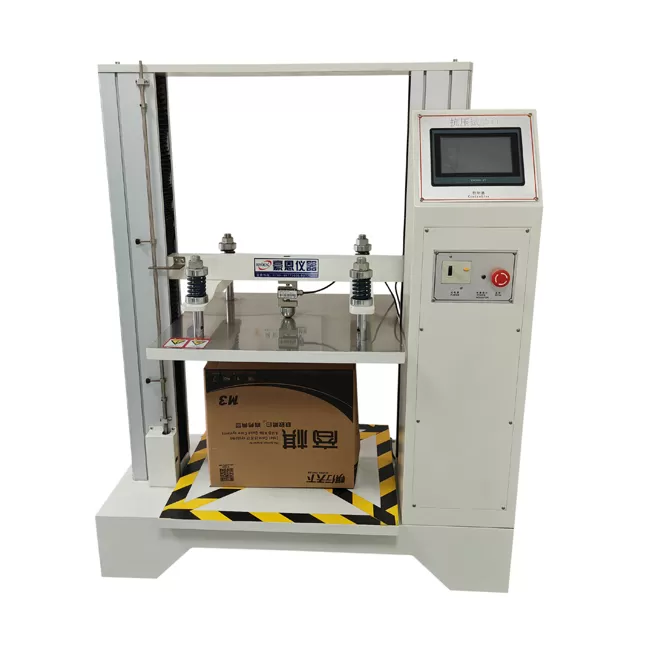
Compression resistance dictates the structural load-bearing capacity of corrugated boxes and fiber drums. Because paper structures are thin, compressive forces frequently cause elastic buckling rather than pure material crushing. Evaluated parameters include:
Short Span Compression Test (SCT): Conducted per ISO 9895 or TAPPI T 826, SCT measures the compressive strength of a paper sheet over an extremely short clamping distance (typically 0.70 mm). This microscopic gap prevents global buckling, isolating the true compressive load capacity of the cellulose fibers.
Ring Crush Test (RCT): Standardized by ISO 12192, RCT evaluates a 152.4 mm long strip formed into a cylindrical channel. While historically prevalent, RCT is sensitive to specimen preparation defects and edge-delamination.
How HAOEN builds this equipment
The chamber described above is designed and manufactured in HAOEN's own plants in Dongguan, rather than assembled from purchased sub-assemblies. That distinction matters when a lab needs repeatable performance across a fleet of machines.
- Chamber geometry, airflow and insulation are engineered in-house and issued as controlled drawings
- Steel is cut, bent and welded on our own line, with stress relief and surface treatment between stages
- Refrigeration, electrical cabinets and sensor harnesses are installed and wired by our own technicians
- Each unit runs a full commissioning cycle with logged test data before the QC file is signed
- Export crating, anti-rust treatment and the complete document set are prepared in-house
Because engineering, production and calibration sit under the same roof, specification changes during a project are absorbed by the factory rather than passed between suppliers. Standard units follow the same route, which is why a catalogue model and a custom-built chamber carry the same documentation discipline.